

CASE STUDY: PASS THE BATON, KenGen
How KenGen Launched a Scalable E-Mentorship Program to Secure Institutional Knowledge and Accelerate Employee Growth
Executive Summary
Facing the dual challenges of an aging workforce and the need to integrate new hires, KenGen identified mentorship as a critical strategy for knowledge transfer and employee development. While a mentorship framework existed since 2016, its reach and effectiveness were limited by traditional, in-person models.
This case study details the successful pilot of KenGen’s “Pass the Barton” e-mentorship program. By partnering with eMentoring Africa to implement a customized digital platform, KenGen transformed its mentorship initiative. The program systematically connected 288 employees across geographical locations, facilitating the transfer of critical institutional knowledge and technical skills. The results demonstrate a scalable, data-driven model that enhances onboarding, supports career progression, and ensures business continuity.
The Challenge: Capturing Tacit Knowledge and Connecting a Dispersed Workforce
KenGen’s initial mentorship framework, approved in 2016, was a step in the right direction but faced scalability and tracking limitations.
- Informal Knowledge Loss: Critical, informal “tacit knowledge”—how things really get done, effective decision-making patterns, and institutional history—was at risk as experienced employees neared retirement.
- Inefficient Onboarding: New employees lacked a structured way to learn the “KenGen Experience,” slowing their integration and effectiveness.
- Geographical and Logistical Barriers: Traditional mentorship models struggled to connect mentors and mentees across different offices and sites.
- Lack of Measurable Outcomes: The impact of mentorship relationships was difficult to track, monitor, and evaluate against clear corporate goals.
The challenge was to create a modern, scalable system that could systematically pass the baton of knowledge from one generation of employees to the next.
The Solution: A Customized, Pillar-Driven E-Mentorship Platform
In 2023, KenGen partnered with eMentoring Africa to launch a bespoke digital mentorship platform. The solution was designed for user experience, brand alignment, and measurable impact.
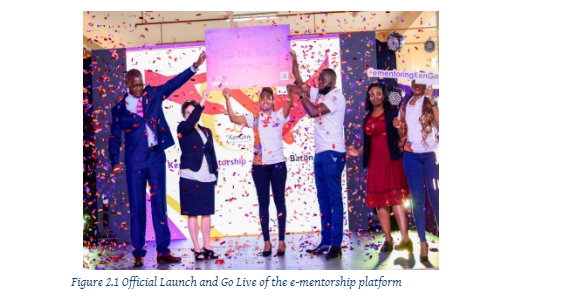
A Phased and Managed Rollout:
- Capacity Building: Personalized training was conducted for System Administrators, Mentors, and Mentees to ensure digital literacy and program success.
- Change Management: A testing phase allowed employees to interact with the platform, providing feedback for improvements before the official go-live.
- Official Launch: The program was officially launched by the Acting MD & CEO in April 2023, signaling top-level support and driving organization-wide awareness.
- Flexible Delivery: Mentorship occurred through one-on-one sessions (virtual or physical) and group mentorship, where a single subject-matter expert could guide multiple mentees on a popular goal.
The Results: Data-Driven Proof of Concept
The 6-month pilot cohort provided tangible evidence of the program’s reach and initial impact.
1. Significant Employee Engagement:
- 288 employees actively participated in the pilot, demonstrating high demand for structured mentorship.
- Mentees were matched with mentors across all six pillars, with the highest demand in KenGen Experience, Career Progression, and Technical Development.
2. Revealing Demand & Gender Insights:
- The data revealed a higher number of male sign-ups, reflecting the company’s overall gender distribution. However, a promising finding was that females who selected goals had a high match rate, indicating active and successful participation.
- The goal distribution data provided an unbiased view of what employees truly wanted, allowing L&D to tailor future support.
3. Operational Success and Adaptation:
- The initial requirement for new hires to complete “KenGen Experience” goals first was identified as a bottleneck. The team swiftly adapted the platform, removing this restriction based on user feedback, which improved user satisfaction and pace.
- The platform successfully facilitated monitoring and evaluation, providing the first-ever data set on mentorship effectiveness at KenGen.
Key Takeaways & Lessons Learned
- Technology is an Enabler, Not a Solution: The customized platform was crucial, but its success was driven by comprehensive change management, training, and strong leadership sponsorship.
- Agility is Critical: The willingness to adapt—such as removing the mandatory goal sequence—based on user feedback was key to maintaining engagement and momentum.
- Data Drives Decision-Making: The platform transformed mentorship from an anecdotal HR activity to a data-rich program, providing clear insights into employee development needs and program ROI.
- A Foundation for the Future: The pilot proved that e-mentorship is a viable tool for onboarding, succession planning, and ensuring business continuity. The recommendation to incorporate a dedicated focal point within HR will anchor this success and link it directly to performance management.
Conclusion:
The “Pass the Barton” e-mentorship program has successfully bridged geographical and generational gaps within KenGen. By leveraging a digital platform, KenGen has created a sustainable, scalable, and measurable system for knowledge transfer that empowers employees, secures institutional memory, and builds a more resilient organization for the future.